While the possibility of a data centre being built on Goolay’yari/Cooks River has generated substantial public controversy, other aspects of the development are being overlooked. Bayside councillors want to move a proposed public park onto the riverfront, swapping industrial buildings with green space. But despite councillors’ belief it is being actively discussed, developer Stockland says it has received no proposal. As a crucial planning deadline approaches, questions remain about whether the idea will receive serious consideration. Niall Edwards-FitzSimons investigates for Goolay’yari Cooks River Radio.
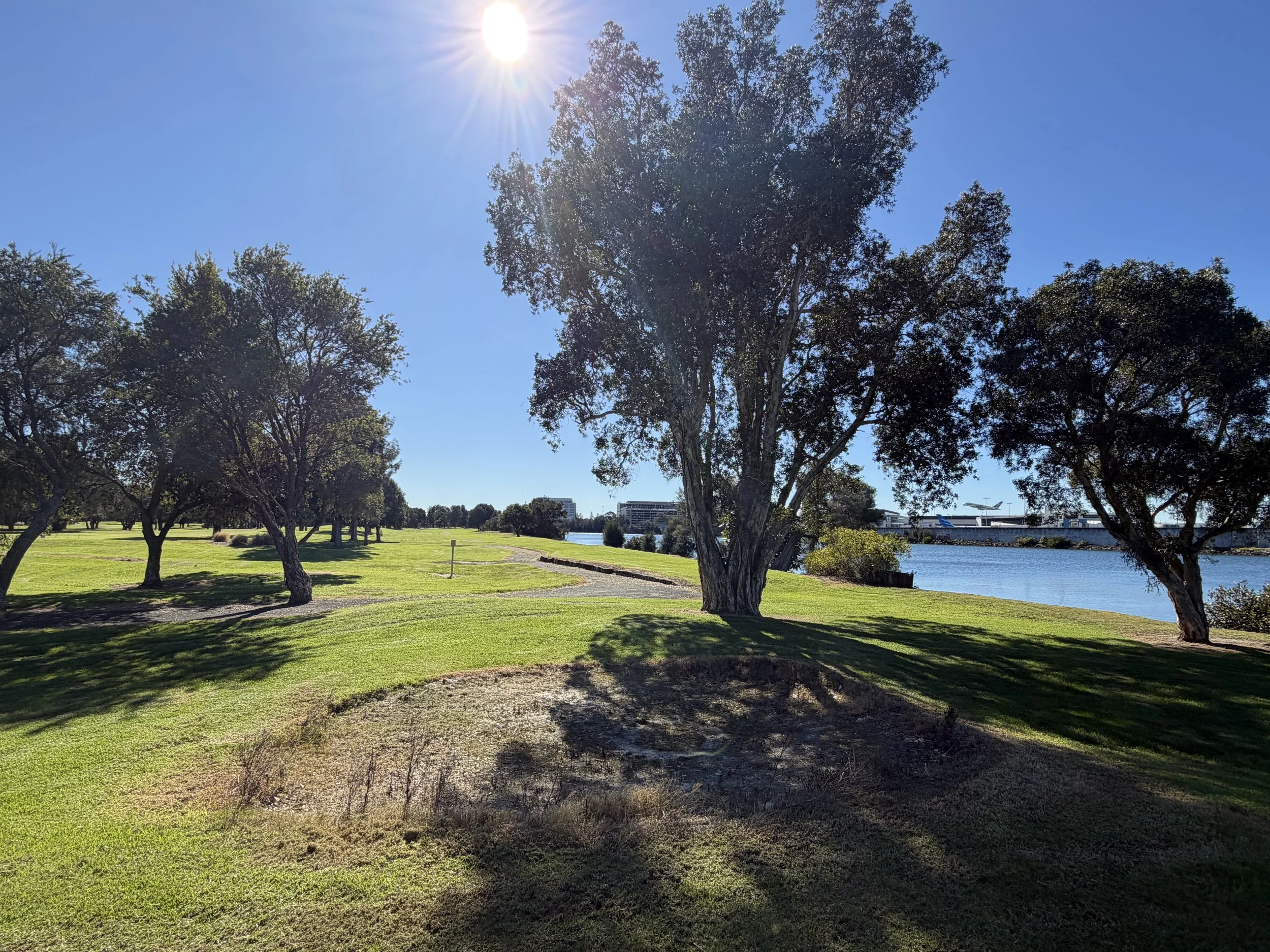
Will a future public park front onto the river? Or will this land be under buildings? Photo: supplied
A proposal to dramatically improve public access to Goolay’yari/Cooks River has become the subject of an unusual disagreement between Bayside Council and the developers of the former Kogarah Golf Course.
While councillors say a land swap could transform the proposed $2.9 billion logistics precinct to better serve the local community, there is uncertainty about whether negotiations are actually taking place.
Under the current development proposal, a new public park would be established on the council-owned half of the golf course, while developer-owned private land immediately beside the river would be occupied by large industrial buildings. A narrow publicly accessible foreshore path would run along the waterfront, but the park itself would be largely separated from the river.
The councillors want to exchange some of the land, allowing the park to extend to the river's edge and relocating the commercial buildings further inland. It's a change that Labor Councillor Soraya Kassim and Greens Councillor Peter Strong believe could produce a substantially better outcome, delivering both a commercially viable development and a valuable public space on one of the last major undeveloped stretches of the Cooks River.
But there is a significant obstacle: the two sides appear unable to agree on whether a land swap proposal has actually been put forward.
In a statement to Goolay’yari Cooks River Radio, Bayside Council confirmed that it had previously discussed a land swap with the developers, and said it would welcome the opportunity to explore the possibility further. Since then, the proposal has appeared in Council’s supplementary submission to the planning portal, and councillors have apparently also been told by Bayside's Mayor and General Manager that proposals for a land swap have been made.
Yet Stockland maintains that it has not received a proposal from Bayside Council.
As the November 8 deadline for the developers’ response to submission looms, this crucial issue is in danger of falling by the wayside.
A park that no-one will visit
For Councillor Kassim, the fundamental problem with the proposed layout is that it fails to take advantage of the riverfront location.
"The point about the park, Pemulwuy Park, is that the park not only should be not overshadowed and not flooded, but should of course address the water," she said. "I mean, that's what people want to do. They want to go and sit in the park, walk up to the river, enjoy it, sit by the river, wander around, do their playing and their walking around the river."
Under the current plans, the proposed warehouses would occupy much of the waterfront, reaching heights of up to 70 metres, while the park would sit in shadow behind them.
"They don't want to sit around and face a building," Kassim said, describing the possibility of visitors having only narrow glimpses of the river between industrial structures.
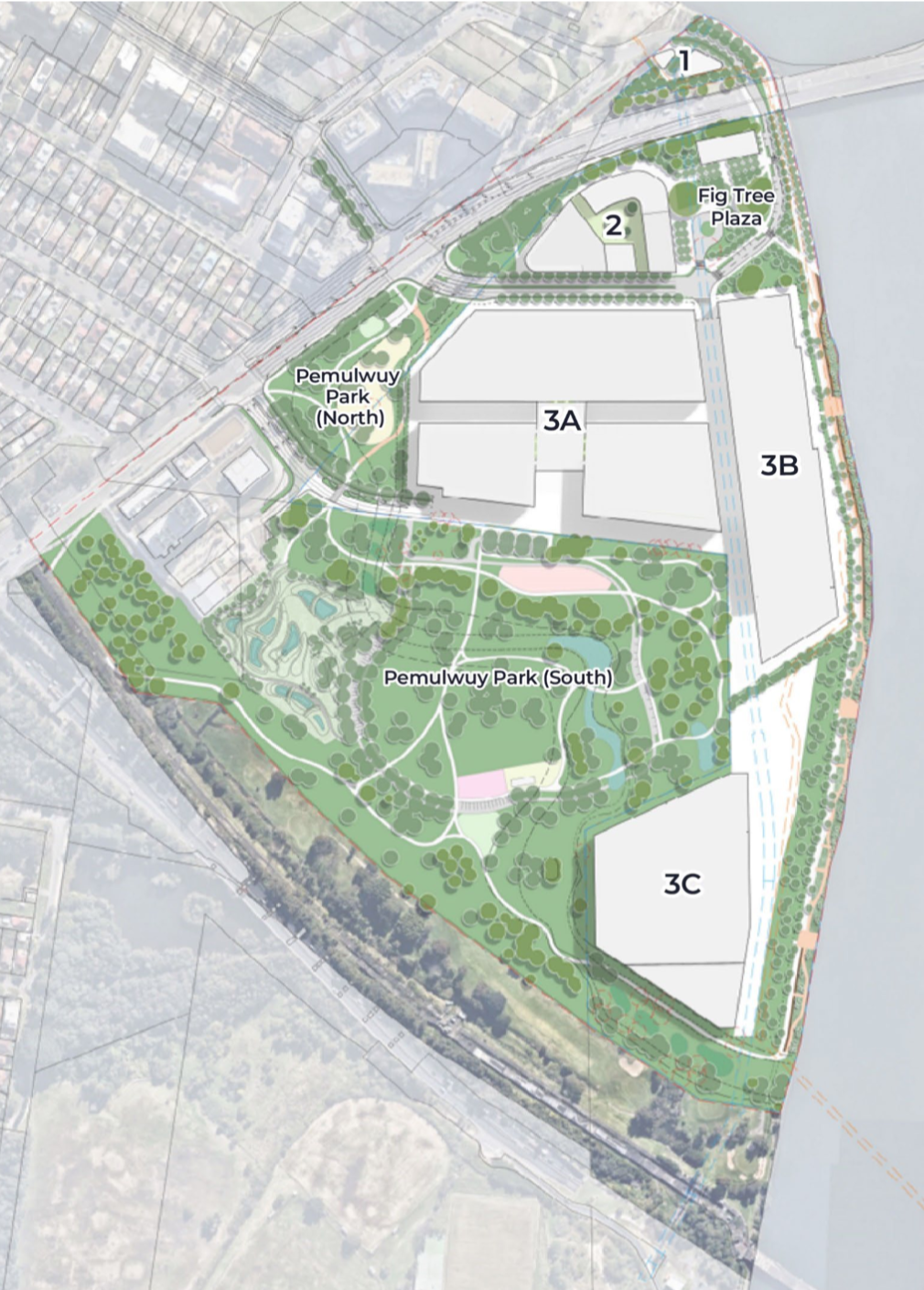
Buildings cut the park off from the riverfront in the current proposal. Scoping Report: Ethos Urban
Bayside Council's concerns extend beyond access and views. In its September submission to the Department of Planning, Housing and Infrastructure, council identified substantial overshadowing of Pemulwuy Park, particularly during winter mornings, and raised objections to proposed flood-management works that would divert water onto council land and significantly alter the park's landscape.
Councillor Strong argues that even if logistics and warehousing development proceeds, the waterfront need not be dominated by industrial buildings.
"If you did reposition the park and the buildings back away from the river, then you could have a wonderful public space along the river," he said. "We can utilize that public space much better."
Councillors argue that rearranging the site could help deliver a more attractive and usable public space, while allowing commercial development to proceed further from the river.
Stockland, however, maintains that the existing proposal already provides substantial public benefits.
The company points to plans for a publicly accessible foreshore, improvements to active transport connections and contributions towards the park and surrounding road infrastructure. The question is whether these benefits could be substantially improved by changing the arrangement of the site, rather than simply proceeding with the existing land boundaries.
The proposed arrangement is closely connected to the site's fragmented land ownership. The former golf course includes parcels owned by Bayside Council and other public authorities, as well as privately owned land, including the riverfront parcel acquired by the developer John Boyd.
The proposed park largely follows the existing boundaries of council-owned land, rather than a layout designed to maximise the public's enjoyment of the river.
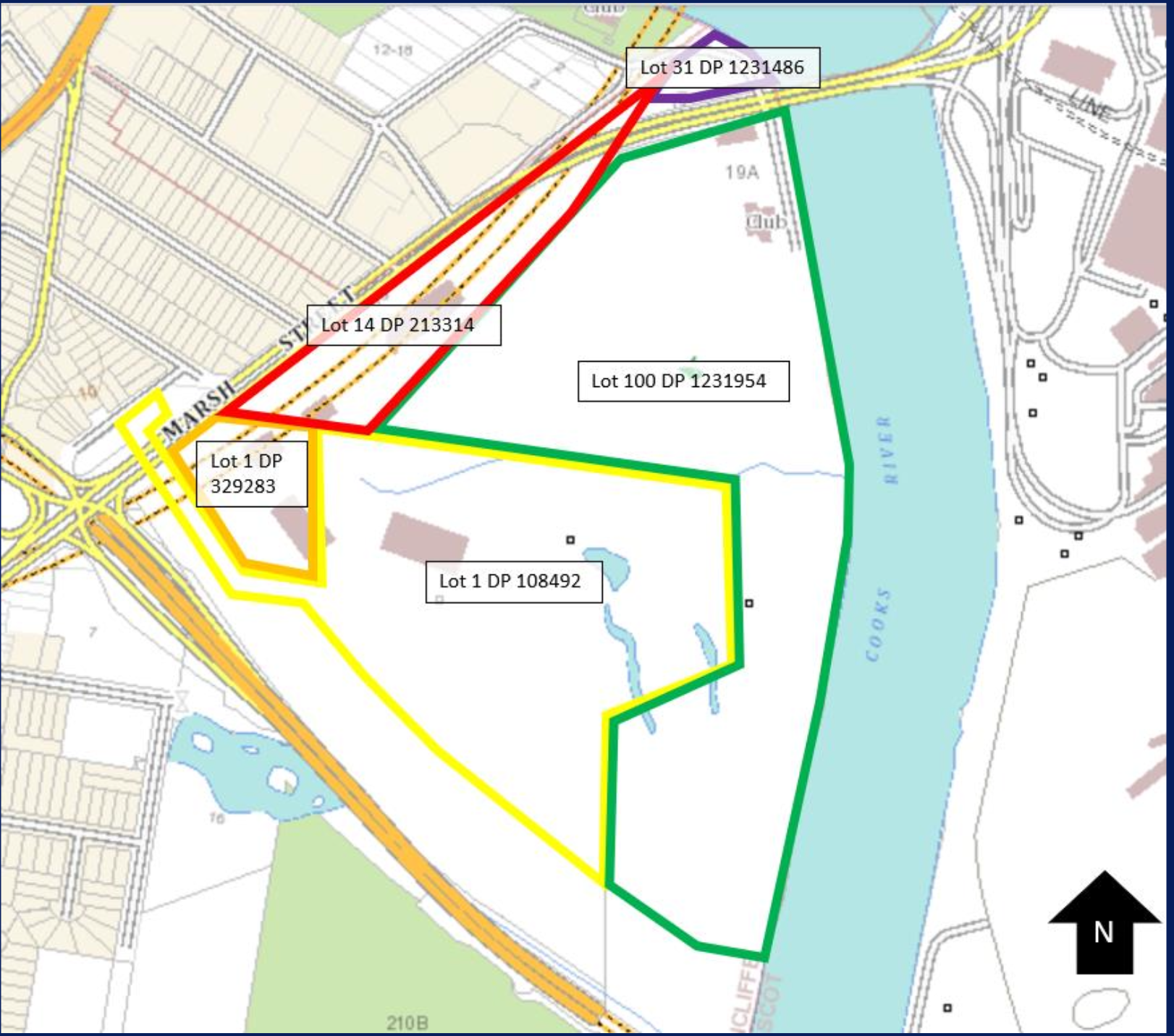
The shape of council-owned (yellow/red) and developer-owned (green) blocks explains the proposed layout. Gateway Determination 2022: NSW Government
The idea of exchanging land is intended to overcome that constraint.
For Kassim, any additional complexity involved in exchanging land would be justified by the long-term benefits. She acknowledged that a land swap could require an exchange agreement and rezoning, potentially adding months to the planning process.
But she argued that such delays should be weighed against the permanent consequences of the development. "We're talking about a forever solution here," she said. "What really is six months in forever?"
Is the offer actually on the table?
The land swap has been the subject of formal discussion and resolutions at Bayside Council. The minutes of the City Planning and Environment Committee meeting on 5 August record a recommendation, moved by Kassim and Strong, that council prepare a supplementary submission about a possible land swap and write to the developer formally suggesting the idea be explored.
The recommendation was adopted by the full council on 26 August and reproduced in its 7 September supplementary submission, sent by Manager Strategic Planning David Smith to the Department of Planning, Housing and Infrastructure. According to Councillor Kassim: "It's not just a mandate, it's a requirement really for council to take forward these discussions.”
Kassim told Goolay’yari Cooks River Radio that her understanding is that the land swap “is certainly something which is being formally put to [the developers].” The councillor was emphatic that the option had been put forward, saying: “so you know, it can’t be said that that option is not clearly there.”
However, Strong was less certain about whether negotiations had actually taken place. "I'm not aware that they've actually had discussions with Stockland over it yet," he said. He indicated that he intended to follow up on the progress of those discussions.
Bayside Council is apparently pursuing the land swap with developers
The uncertainty is compounded by the differing accounts now emerging from council and the developer.
I asked Stockland why a land swap hadn't been pursued further after the earlier discussions with Bayside Council, and whether the developer would take council up on its offer to explore the idea.
These questions were not addressed directly in the response. Instead, a Stockland spokesperson said: "Stockland and Bayside Council continue to engage constructively about the longer-term future of the precinct, though there is no current land swap proposal."
When I pressed the developer again on why it wasn't pursuing the option, given council's stated willingness to discuss it, I was told that Stockland had not received a proposal from Bayside Council.
The discrepancy raises questions about whether council staff have failed to actually pursue the matter, or whether the developers are intentionally obfuscating with their understanding of what constitutes a ‘discussion’ vs a ‘proposal’.
Will developers listen to the community and council?
The debate comes as Stockland prepares its formal response to the hundreds of submissions lodged during public exhibition of the project, the vast majority of which objected to the redevelopment proposal. The response is expected by 8 November, four months after the exhibition period closed in July, although Stockland would not confirm whether it will meet that deadline.
Stockland also provided no answers about whether it’s planning to flag any changes to the proposal in its response, for example removing the controversial plans for a data centre on the site.
The protest movement that has coalesced around the group SCRAP (Stop The Cooks River AI Project) has focused its opposition particularly on the data centre. However conversations with organisers suggest that its removal from the plans wouldn’t necessarily resolve their concerns.
SCRAP organiser Paddy Gibson hopes the movement can develop a broader alternative vision for the land.
"I do hope that there's momentum that's generated by this that can carry on to actually put forward an alternative vision for the site that is about protecting the ecology, and respecting the place," he said.
Gabby, an ecologist involved in SCRAP, suggested that the movement's broader purpose lay in supporting the community's aspirations for green space and a meaningful say in local development decisions.
"I really do think people just want agency to decide what happens in their area, and I think SCRAP wants to support the community in realizing those shared values," she said.
Fellow organiser Caitlin Boyce said discussions with residents had revealed concerns about the legitimacy of building a logistics hub on the site at all.
"It's private land, but the community is against it," she said.
However, she acknowledged that it was difficult to predict whether the campaign would maintain its momentum if the data centre was removed.
Councillor Strong, who is also part of SCRAP, is optimistic that the group could shift its focus as the proposal evolves.
"These people are together now. It's often very hard to start a group, but once you've got a group together, I think that group can then shape-shift its focus, as the development plans change," he said.
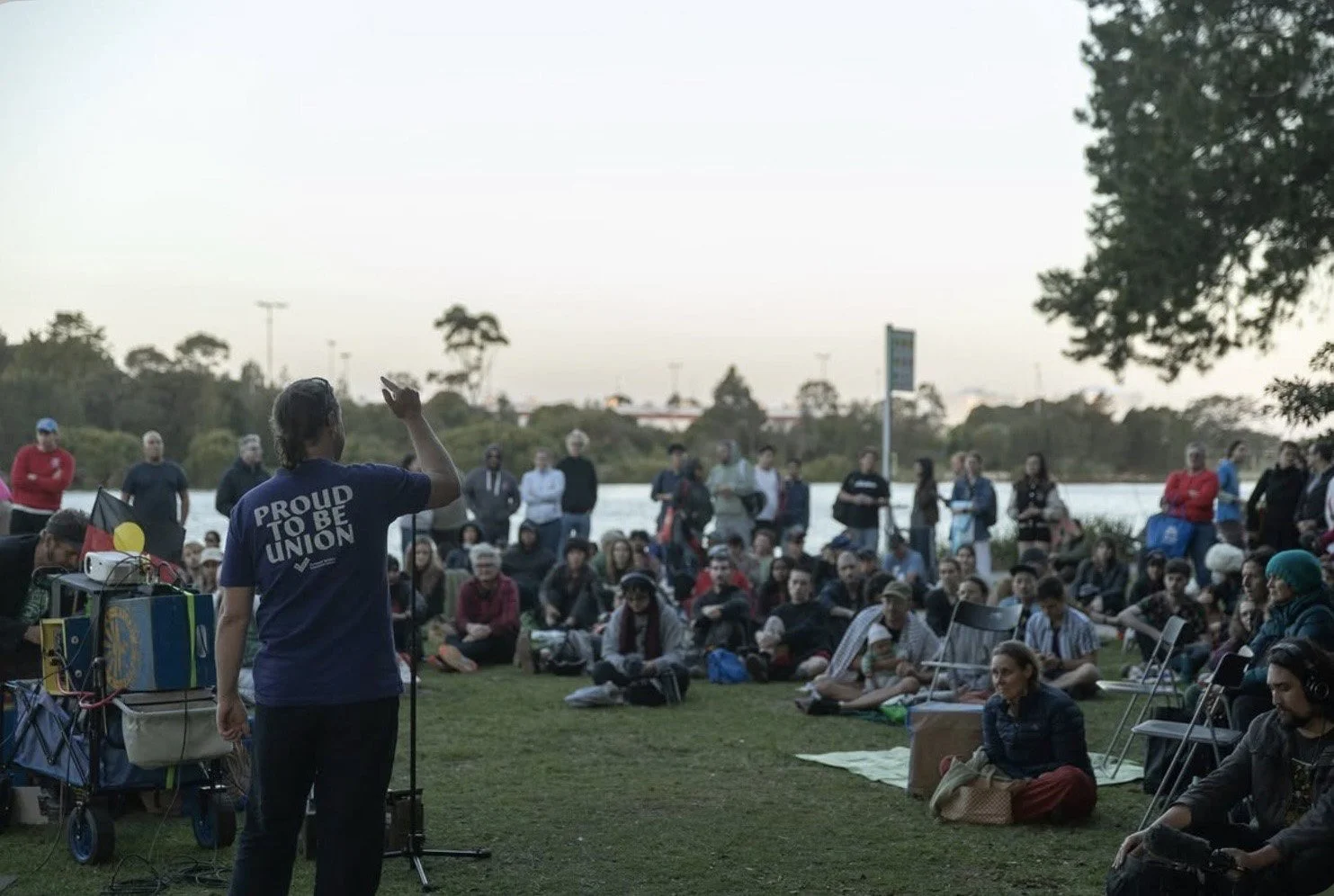
It’s unclear whether removing the data centre will be enough to assuage the nascent community campaign. SCRAP
For now, it remains uncertain whether the wider community campaign will broaden its focus to include the land swap proposal. But the councillors are hopeful that growing public pressure will encourage Stockland to reconsider aspects of its plans.
"I don't feel like it's in their interest to just bulldoze through the original proposal," Strong said.
Kassim likewise believes the developer has an opportunity to demonstrate that it has listened to the community.
“It will now be up to the…proponent to actually take this opportunity, grab it, you know, take it and go ‘this is our opportunity to come out, maybe not as heroes, but definitely not as villains, if we actually do listen…[to] what the residents and council would like,’” she said.
With the response to submissions approaching, the future of the precinct remains unresolved. The possibility of a land swap offers a way to reconcile some of the competing demands for economic development, environmental protection and public access.
The decisions made now will shape this stretch of Goolay’yari/Cooks River for generations. Once the warehouses are built, the opportunity to create a substantial riverside public park will be gone for good.
— Niall Edwards-FitzSimons for Goolay’yari Cooks River Radio
To hear more about this story, listen to the podcast version below, or on podcast platforms: