Plans for a logistics hub and possible data centre at the former Kogarah Golf Course have sparked a growing protest movement, bringing together activists, Aboriginal custodians and local residents concerned about the future of Goolay’yari/Cooks River. Meanwhile, councillors on Bayside Council are railing against their lack of input in this ‘state significant development’ and calling for major changes to the proposal.
With the developer’s response to submissions imminent, questions are being asked about what input, if any, the community will have into what the development will look like. Many are asking for better consultation, some are advocating that the whole site be turned over to the public, or to nature, or to Aboriginal custodianship. Niall Edwards-FitzSimons investigates for Goolay’yari Cooks River Radio.
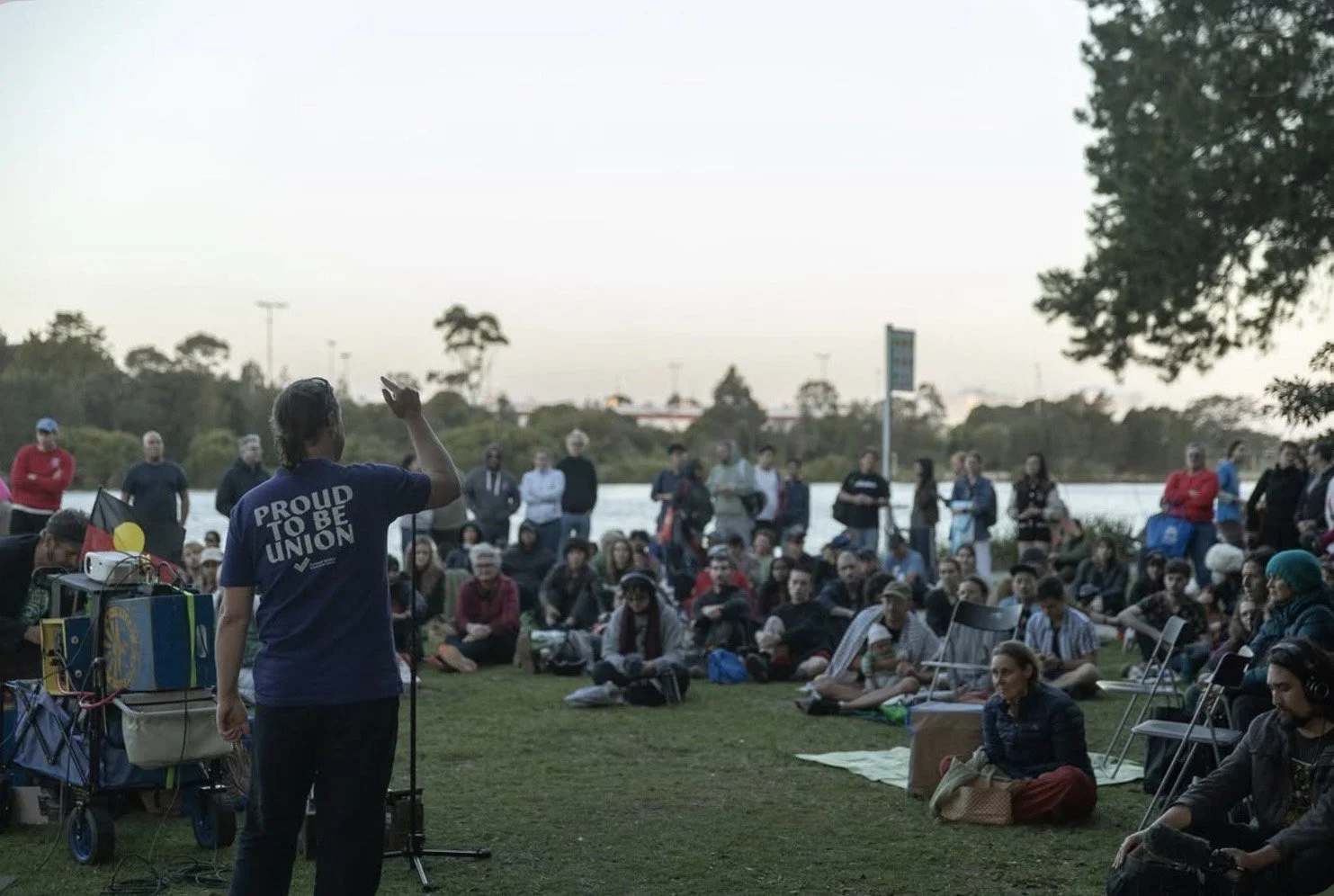
Paddy Gibson addresses the crowd at the SCRAP protest on October 9 in Cahill Park, Arncliffe. SCRAP
On the banks of Goolay’yari/Cooks River, a growing community movement is challenging plans to redevelop the former Kogarah Golf Course (KGC). Organisers are questioning not only the environmental impacts of a proposed logistics hub and potential data centre, but who should have a say in the future of one of Sydney’s most significant riverfront sites.
The redevelopment proposal, put forward by property developers Stockland and John Boyd, has become a flashpoint for community discontent along the Cooks River, with campaigners raising concerns about ecological damage, pollution, energy consumption and the loss of green space.
At the centre of the opposition is a grassroots group called SCRAP (Stop the Cooks River AI Project). On 9 October, the group held a community protest at Cahill Park in Arncliffe, overlooking the river near the site of the proposed development. The evening gathering included music, speeches, a barbecue and a screening of Aunty Rhonda's Walk, a short film made by Bidjigal/Gadigal/Dharug/Yuin Elder Aunty Rhonda Dixon-Grovenor.
For organisers, the gathering was an opportunity to demonstrate the strength of local opposition and build a movement capable of influencing the development's future.
"This is a special place for so many of us," said SCRAP organiser Dr Paddy Gibson, a historian at the Jumbunna Institute at UTS. He described the river as somewhere people have gathered for thousands of years to connect with the landscape.
Gibson pointed to more than 600 public submissions responding to the development application and thousands of signatures on a petition as evidence of widespread community concern. "I thought, 'Okay, we've actually really got to fight this, and demonstrate that it's not okay to just plow ahead and do these developments without consideration.'"
A data centre on the riverbank
Although the data centre is just one possible use for one of the buildings outlined in the development proposal, campaigners argue that the scale of the infrastructure being contemplated warrants serious scrutiny.
Gibson rejected suggestions that SCRAP was sensationalising the possibility of the data centre. He pointed to the proposal's reference to an 80-megawatt facility, comparing it to the 90-megawatt facility proposed at Lane Cove that was subsequently withdrawn following community opposition.
According to Gibson, the Lane Cove proposal involved storing approximately one million litres of fuel on-site to power 49 backup generators. Although the precise requirements of any data centre at the KGC site have not been established, he argued that a facility of comparable size could bring similarly substantial fuel-storage requirements to the banks of the Cooks River.
"That's an incredible risk to the river," he said.
Gibson also argued that an 80-megawatt facility could consume approximately twice as much electricity as all households in the Bayside local government area combined.
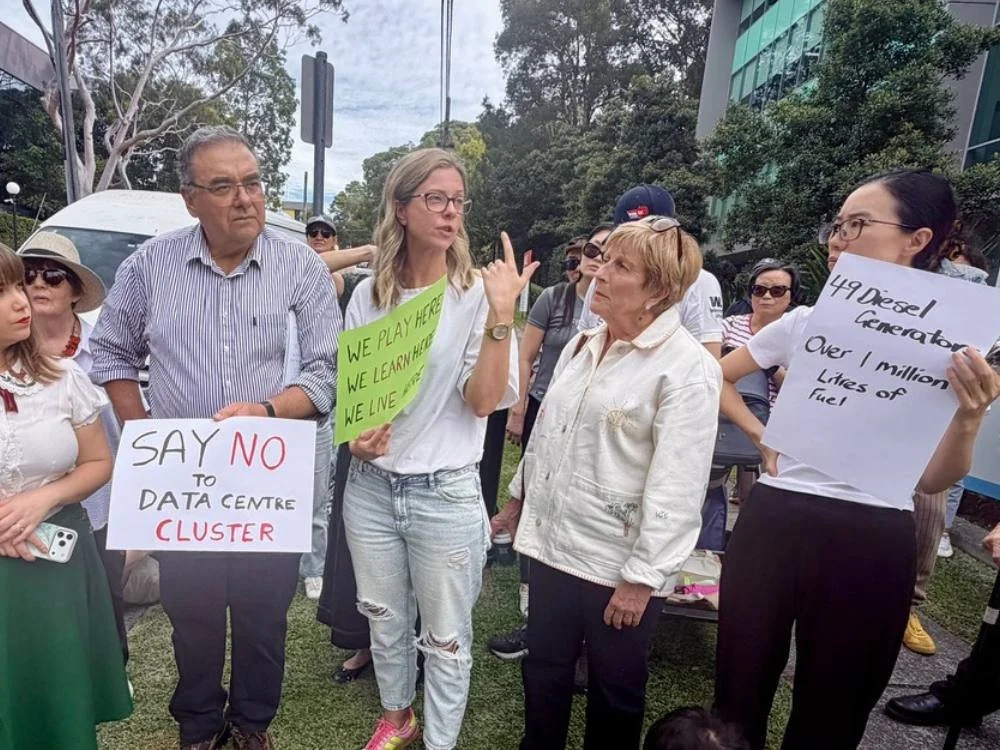
A proposed data centre of similar size in Lane Cove was recently withdrawn after extensive community protest. In The Cove
For fellow organiser Caitlin Boyce, who grew up in the area, the proposal has also exposed deeper frustrations about the community's limited influence over development decisions.
"I think that there are the obvious [issues] that people often cover about like heat, light, chemical pollution. But I think that this is also raising really interesting questions about people's say over what gets built," she said.
"It seems like they thought, to put it simply, that they were going to get away with it, and it's clear that the community has said, you know, absolutely not, that there's going to be a fight if they want to try to do this."
Boyce said the campaign's focus on the data centre reflects concerns about the environmental, economic and political consequences of expanding AI infrastructure. But opposition to the proposal extends beyond that particular use.
"In the conversations we have been having with people, they don't want the logistics hub either," she said. "People have been talking about why can't we have public housing? Why can't we have, you know, wetlands? Why can't we have these things?"
An overlooked ecological refuge
Despite its history as a heavily modified recreational landscape, the proposed site of the development contains areas of established vegetation, remnant wetlands and habitat supporting native wildlife. The proposal has attracted opposition from campaigners concerned about the ecological value of the former golf course.
Remnant wetland and visiting wildlife on the Kogarah Golf Course. Video: supplied
Gabby, an ecologist and SCRAP organiser, said the site's biodiversity was easy to underestimate. But, she said, "if you walk down there, there are water birds, there's spoonbills, there's herons, there's wood ducks, there's butcher birds, magpies, magpie larks. It's teeming with bird life."
Of particular concern is the presence of the endangered Green and Golden Bell Frog, which has been recorded on the site. The proposed development would remove two areas of habitat where the vulnerable species lives.
Gabby pointed to the dramatic decline in the frog's distribution, which she said had fallen to around 10 per cent of its former range. "If we know that there is habitat for this species on site, we know that the species is there, why are we not doing more to protect it?" she asked.
Gabby argued that green space and development need not always be mutually exclusive, but that ecological protection should be central to the design of any new precinct, rather than treated as a separate benefit delivered elsewhere.

The endangered Green and Golden Bell Frog has been recorded at the site—the proposal includes destroying frog habitat. Bernard Spragg
The importance of protecting the site's natural environment was also central to the contributions of Aboriginal speakers at the October protest.
Jordan Ryan-Hennessy, a bush regenerator and Bidjigal/Gweagal man, described the site as one of the few remaining places along the river supporting native vegetation and wildlife habitat. He spoke about the importance of protecting endangered ecological communities, including Eastern Suburbs Banksia Scrub, and argued that environmental destruction could not be separated from human wellbeing.
"You don't have to be Aboriginal to care for country and to be a part of the land," he told the gathering.
Bidjigal/Gadigal/Dharug/Yuin elder Aunty Rhonda Dixon-Grovenor, who delivered the Welcome to Country, offered another vision for the site's future, suggesting it could become an eco-cultural centre that supported native wildlife and maintained connections to Country.
"We want to encourage the birds and the animals and the fish to come, and so that we can continue with our connection to country and water," she told protesters.
Councillors challenge the proposal
Opposition to the redevelopment is not confined to community campaigners.
Councillors from both the Greens and Labor have expressed serious reservations, particularly about the proposed data centre and the treatment of land adjoining the river.
The Greens have been particularly active in opposing the proposal, with representatives from several local councils attending the SCRAP protest. Inner West Greens Councillor Olivia Barlow said she was impressed by the turnout, while fellow Councillor Izabella Antoniou argued that the gathering demonstrated widespread community concern. "They care about the river. They care about their home.”

The NSW Greens petition against the proposal has collected over 3000 signatures. NSW Greens
Asked whether the Greens were using the controversy as a political campaigning opportunity, Barlow rejected the suggestion. "I think that's a disappointing take because I think the Greens have always stood really strongly on not only environmental rights, but also the importance of involving our community in decisions like this," she said. "When you look around and you see the combination of so many different local organisations and just individuals coming out who care about their community, you can see that's patently false," she said.
Bayside Greens Councillor Peter Strong, who is also involved in SCRAP, said the proposal had changed considerably since it was first presented to a council committee. Originally, he said, the plans focused on logistics and warehousing, with an active transport corridor along the river. The subsequent inclusion of a data centre raised alarm bells.
Strong said Bayside Council lodged a submission opposing aspects of the proposal, alongside hundreds of submissions from the public. For him, the site's importance lies partly in the ecological recovery that has occurred since the golf course closed.
"Wildlife has moved back in. We see sea eagles," he said. "If there is going to be development, I think they really need to...nurture what...has grown there over the last few years in this natural habitat."

Bayside councillors Soraya Kassim (Labor - L) and Peter Strong (Greens - R) have been vocal in calling for changes to the proposal. Bayside Council
Bayside Labor Councillor Soraya Kassim has also been outspoken about the possible data centre. Kassim argued that while the site's proximity to Sydney Airport and Port Botany made it a logical location for certain commercial and industrial uses, a data centre would be inappropriate beside a major residential area and an environmentally sensitive river.
"Data centres just don't need to be near places where many humans live," she said.
Kassim also emphasised the importance of rehabilitating a river that has suffered from two centuries of colonisation: "we want to try and improve its quality. It's had an awful beating from humans over the last couple of hundred years.”
Strong similarly raised concerns about the consequences of intensive construction beside the river, alongside the longer-term demands for energy and water and the potential for noise and pollution. He questioned whether the proposed infrastructure would be compatible with a river corridor intended to provide public recreation and active transport.
The councillors' concerns are significant, but their ability to directly influence the outcome is limited.
Because the proposal is being assessed as a state significant development, Bayside Council is not the consent authority. The decision ultimately rests with the state's Independent Planning Commission rather than local councillors.
Strong acknowledged that while council has an important role as a stakeholder, it cannot simply reject the development. "It can't pull the plug on the proposal. But it can help shape it," he said.
Different visions for the riverfront
Not everyone opposing the data centre wants to prevent all development on the site.
While some SCRAP organisers favour protecting the entire area from further industrialisation, the two Bayside councillors outlined visions that would accommodate commercial activity alongside greater public and environmental benefits.
Strong said his ideal outcome would involve Aboriginal stewardship of the land, with workshops, community activities and no logistics hub. But, recognising the possibility that redevelopment will proceed, he argued for environmentally sustainable building design, including rooftop solar panels, and for retaining as much natural habitat, tree canopy and public space as possible.
Kassim similarly envisaged a precinct combining logistics with a hotel, retail facilities, public recreation and green space. She suggested sports fields could potentially be built on top of logistics buildings, while existing trees and natural ponds could be retained.
"It could be a fantastic thing for the community," she said.
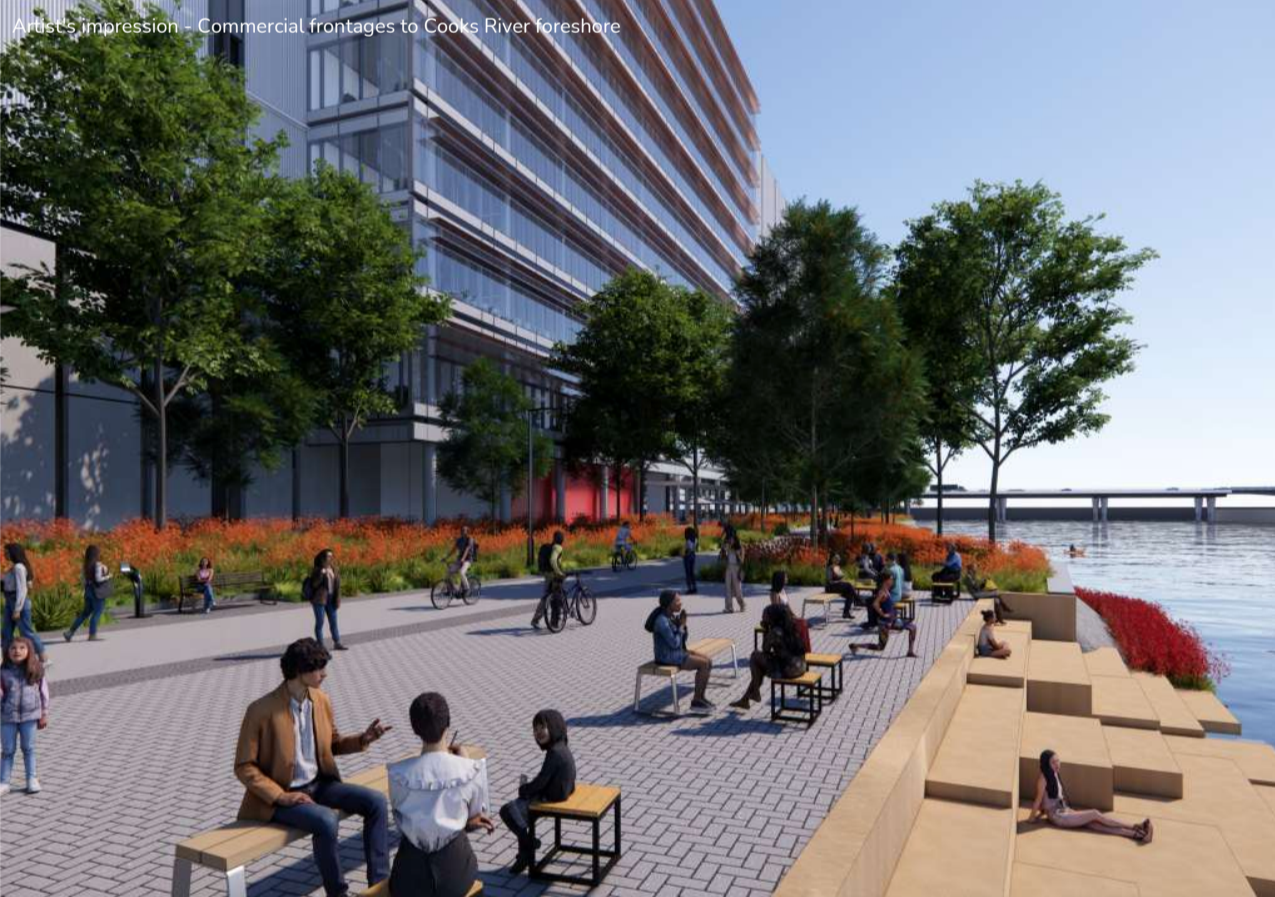
An artists’ rendering shows community use of the narrow proposed riverfront strip. Stockland
Both councillors emphasised the importance of making the riverside more accessible and attractive for residents, rather than allowing large industrial buildings to dominate the waterfront.
Kassim argued that the eventual development should support both economic activity and the everyday lives of people living nearby. "Ideally, yes, we have a, a beautiful logistics hub which supports the New South Wales economy, and we have a liveable space for all the residents and any other visitors want to come," she said.
Despite their different visions, both councillors argue that the river and its ecological values should play a much more prominent role in shaping the development.
Will the developers listen?
Whether the developer will make substantial changes to the proposal remains uncertain.
A Stockland spokesperson told Goolay'yari Cooks River Radio that its project team was reviewing matters raised by community members, Bayside Council and government agencies, and that its formal response to submissions would be made available through the NSW Planning Portal once lodged. The company did not provide a timeframe for that response, but the requirement to lodge it within four months of the end of public exhibition means it should be available by November 8th 2026.
The possibility of the data centre being dropped has been a particular focus of speculation. But even if that element is removed, it remains unclear whether other concerns about the proposed development will be addressed.
There are also continuing questions about the quality of consultation between the developer and local community organisations. Representatives of river groups have described difficulties securing meetings with the development team, with arrangements repeatedly postponed or cancelled.

Both the Cooks River Alliance and the Cooks River Valley Association have had trouble securing a meeting with developers
Councillor Strong said the Cooks River Alliance had arranged a meeting, including agreeing on a date, time and venue, before it was cancelled by the developers. The Cooks River Valley Association has reportedly experienced similar difficulties, with proposed meeting times withdrawn after agreement had apparently been reached.
A Stockland spokesperson attributed the changes to availability and scheduling conflicts.
The company also said it had already met with several community groups, although it did not identify which.
Members of the River Canoe Club, who did secure a meeting, described the experience as being more focused on presenting the development team's plans and claimed public benefits than on listening to concerns or engaging in substantive discussion.
A Stockland spokesperson said that its priority remained progressing the concept master plan, while describing its engagement with Bayside Council about the precinct's longer-term future as constructive.
For Councillor Kassim, the next stage offers the developer an opportunity to demonstrate that it has taken public concerns seriously.
"All will be forgiven basically, in terms of not having done adequate public consultation earlier, if in fact they do listen to the public now," she said.
Strong also expressed hope that the scale of community mobilisation would prompt meaningful changes.
"I don't feel like it's in their interest to just bulldoze through...the original proposal," he said. "The fact that there's been these huge gatherings, these huge series of various events and the public coming together in their hundreds, I think that they have to be listening to that.”
A movement for the river's future
Whatever happens to the data centre, the campaign has brought together a new network of people concerned about the future of the Cooks River.
Gabby described the October gathering as an encouraging experience, particularly as someone taking part in community organising for the first time.
For Caitlin Boyce, the campaign is also about restoring a sense of agency to residents who may otherwise feel powerless in the face of major development decisions. "We can get organised, we can fight it," she said.
Gibson hopes the momentum generated by the protests can encourage a broader movement. "I do hope that there's momentum that's generated by this that can carry on to actually put forward an alternative vision for the site that is about protecting the ecology, and respecting the place."
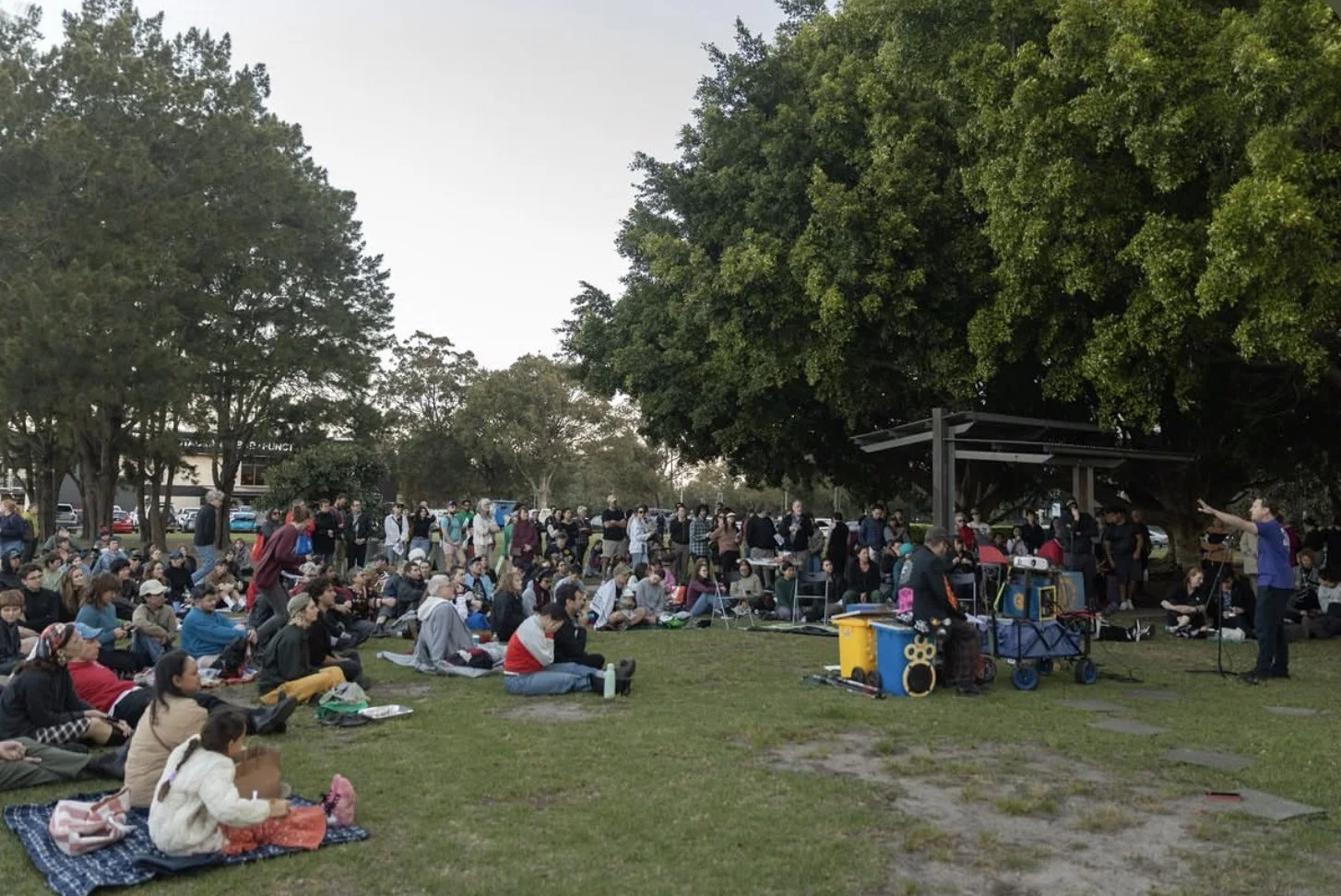
Organisers estimated 250 people attended the October protest in Cahill Park, Arncliffe. SCRAP
For Gabby, the issue ultimately comes down to something more fundamental than the merits of any particular development. "I really do think people just want agency to decide what happens in their area," she said.
With Stockland's response to submissions still outstanding and the Independent Planning Commission's decision yet to come, the ultimate outcome remains uncertain.
But the growing campaign has highlighted the question of who gets to shape the future of Goolay’yari/Cooks River, and how much influence the people who live alongside it should have over decisions that will affect the river for generations to come.
– Niall Edwards-FitzSimons for Goolay’yari Cooks River Radio
To read all the statements we received for this story in full: click here
To hear more about this story, listen to the podcast version below, or on podcast platforms: